Father of the Bride Speech: What to Say (With Examples)
Writing your speech this week?
Generate a personalized father-of-the-bride speech in about 15 minutes — based on your real stories, not a template.
Start My Speech — FreeFree to start · No credit card required
Imagine standing up at her wedding and finding the words — start free →
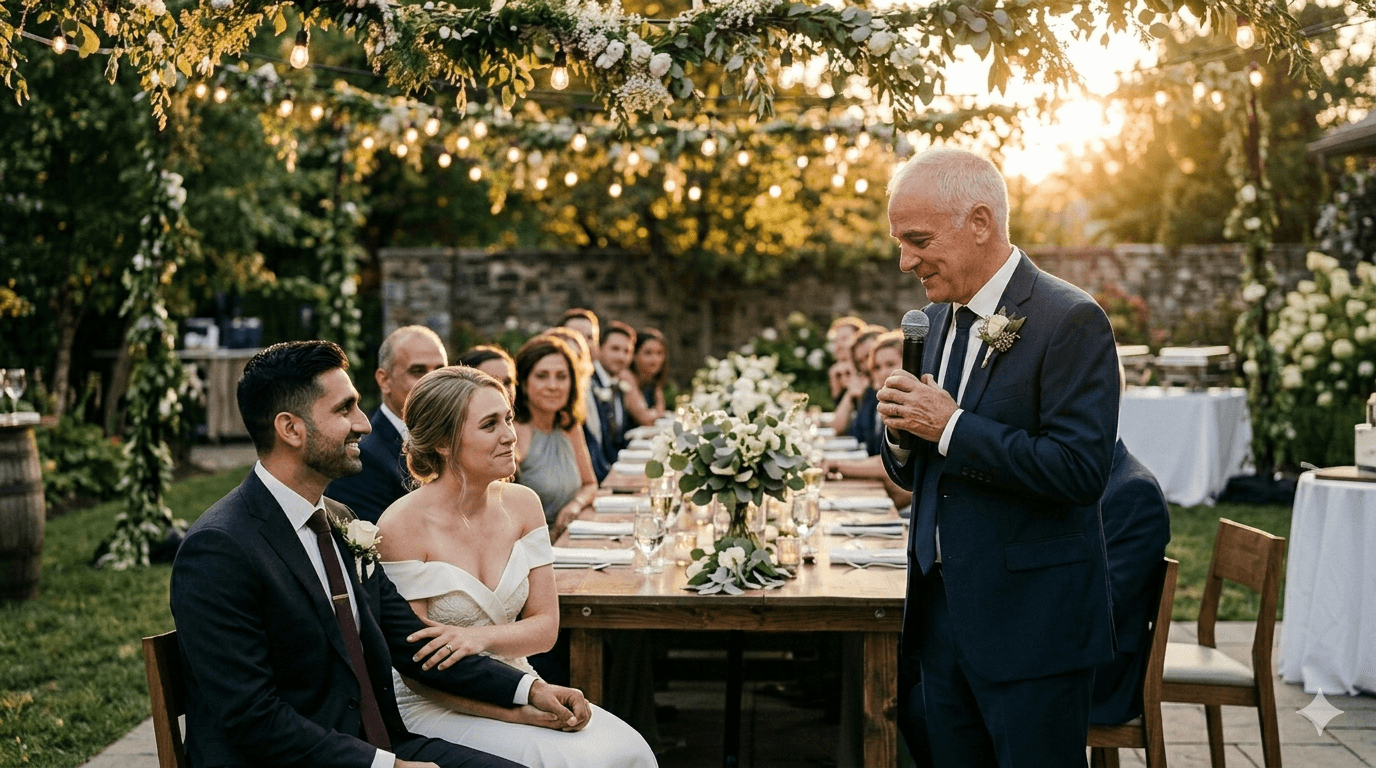
Standing up to speak as the father of the bride is unlike any other moment at the wedding. You are not there to be the funniest person in the room, and you are not there to steal the show. You are there because you have watched a life unfold from the first breath to this threshold — and everyone in the room knows it. That is why the silence feels heavier. That is why your hands might shake. And that is why so many fathers worry they will say too much, too little, or the wrong thing entirely.
The good news is that the speech people remember is rarely the most polished. It is the one that feels honest. Your daughter is not grading your delivery. She is listening for something simpler: that you see her, that you are proud of who she has become, and that you welcome the person she has chosen. If you anchor your words in those truths, you are already on solid ground.
What Your Daughter Wants to Hear
Weddings can turn speeches into performances — punchlines, crowd work, the pressure to “crush it.” A father of the bride toast is different. It is a moment of connection more than entertainment. Your daughter wants to feel known, not summarized. She wants to hear the steadiness in your voice when you talk about her character, not just a list of accomplishments that could belong on a résumé.
She also wants you to welcome her partner with sincerity. A warm, specific compliment lands better than a generic welcome. Think about what you have genuinely observed: how they make her laugh, how they show up when it matters, how they respect her independence while choosing her anyway. Those details signal that your blessing is real — not obligatory.
Finally, she wants you to be present. If you are racing through cards or hiding behind your phone, the room feels it. If you look at her, even when your eyes sting, the room feels that too. Vulnerability, held with composure, is one of the most moving gifts a father can give on a wedding day.
A Simple Structure That Works
You do not need a complicated outline. A clear arc helps you stay grounded and helps guests follow along. Here is a five-part structure many fathers use because it balances emotion, story, and forward-looking hope without wandering.
1. Open with a memory of her as a child
Choose one memory that reveals her spirit — not the cutest anecdote you can find, but one that still feels true today. Maybe it is the way she insisted on fairness, or how she threw herself into music, or how she calmed a younger sibling without being asked. A single vivid scene beats a highlight reel. It tells the room, “I have been paying attention all along.”
2. Acknowledge who she has become
Bridge then to now. Name the qualities you admire in the adult she is: courage, kindness, discipline, humor, loyalty, creativity — whatever fits. If you can connect those traits to choices you have watched her make, the praise lands as evidence, not flattery. This section is where many fathers quietly tear up, and that is alright. You do not have to apologize for it.
3. Welcome the partner genuinely
Speak to your new son-in-law or daughter-in-law directly, at least for a sentence or two. Thank them for loving your daughter well. If their family is present, a brief, gracious nod to them can widen the warmth in the room. Keep it inclusive: this is a union of families, not a transfer of ownership.
4. Share your hopes for their future
Hope does not have to sound like a fortune cookie. It can sound like encouragement: that they keep choosing each other on ordinary Tuesdays, that they protect tenderness even when life gets loud, that they build a home where both people can grow. One or two concrete wishes — rooted in what you believe marriage actually requires — will resonate more than vague platitudes.
5. Raise a glass
End clean. A short toast gives everyone permission to exhale, cheer, and return to the celebration. Name both partners, express your love and pride, and invite the room to join you. If you practice nothing else, practice this last paragraph until it feels natural in your mouth.
Example Openings
Openings set the tone. You want warmth without rambling, specificity without inside baseball. Here are three different ways to begin — each with a note on why it works.
Opening A: The small moment
“When {daughter's name} was little, she used to line up her stuffed animals like they were a jury — serious faces, full deliberation. I should have known she would grow into someone who thinks deeply and cares fiercely about what is right.”
Why it works: It is visual, gentle, and it quietly praises character. It invites laughter without demanding it, and it moves naturally into who she is now.
Want something like this, but with your own story?
Tell us about your daughter — a childhood memory, a quirk only you know — and get a speech draft that sounds like you.
Generate My SpeechFree to start · No credit card required
Opening B: The honest father
“I have been dreading this speech — not because I do not have anything to say, but because there is too much. How do you compress a lifetime of love into a few minutes? So I will do what every father learns eventually: I will do my best, and I will mean every word.”
Why it works: It names the nerves many guests are feeling on your behalf. That honesty creates instant empathy and lowers the pressure to be perfect.
Opening C: The pivot to partnership
“For years, my job was to help {daughter's name} feel safe in the world. Today is not the end of that — it never ends — but it is the day I get to say thank you to the person who will walk beside her as she keeps building a beautiful life.”
Why it works: It honors tradition without sounding possessive, and it sets up a sincere welcome to your daughter's partner in the very first breath.
Common Mistakes
Most toast missteps come from good intentions. A little awareness goes a long way toward keeping the focus where it belongs — on the couple, and on the love in the room.
- Being too long. Guests are hungry, the schedule is tight, and emotion fatigues an audience faster than you think. A tight speech feels confident; a sprawling one feels anxious — even when every sentence is heartfelt.
- Making it about yourself. A little self-deprecation is fine; a monologue about your own wedding, career, or philosophy is not. The starring roles belong to your daughter and her partner.
- Inside jokes nobody understands. If three people laugh and two hundred people check their phones, you have lost the room. If a story matters, add one bridging sentence so everyone can appreciate why it matters.
- Reading from your phone the whole time. Phones are convenient, but they can flatten warmth. Print notes if you need them, or use a small card. Glance down, then look up — especially at your daughter — when you say the important lines.
How Long Should It Be?
Aim for three to five minutes — roughly 400 to 600 words if you are speaking at a comfortable pace with a pause or two for laughter and applause. That is enough room for a meaningful story, genuine praise, a welcome, and a toast, without turning the moment into a keynote.
If you are unsure, rehearse out loud with a timer. Notice where you rush (usually the emotional parts) and where you wander (usually the transitions). Editing is kindness — to your daughter, to the guests, and to your own nerves.
Still Staring at a Blank Page?
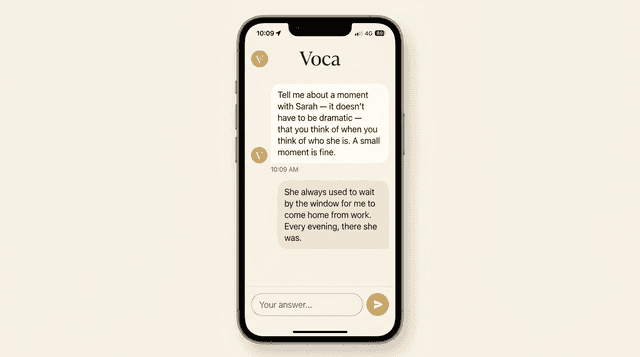
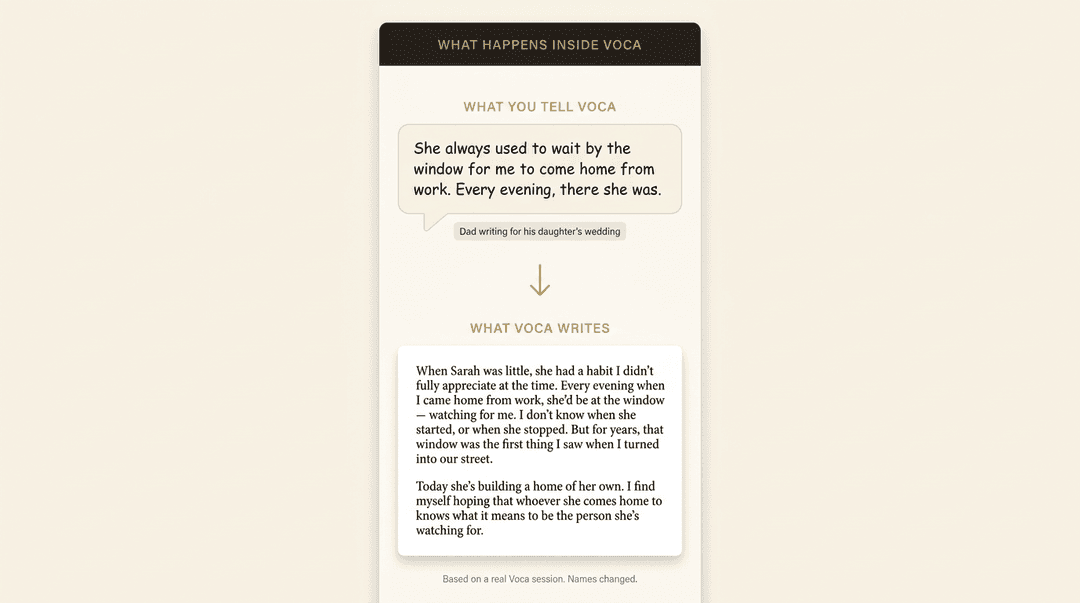
You already have the material — the memories, the pride, the nerves. What you need is a way to turn all of that into something you can actually stand up and say. That is exactly what Voca does: you talk through your stories, and it shapes them into a speech that sounds like you, not a template.
Your speech could be ready in 15 minutes
No templates, no generic filler. Just your real stories, structured into a speech you'll be proud to deliver.
Start Writing Now — FreeFree to start · No credit card required